For centuries, only future leaders had a tutor of their own. Now your child can.
Thirty minutes a day, from 4th grade, compounding for eight years.
Request an invitationWhat a little every day does
A little better every day.
The same every day.
We believe leaders are built, a little every day
The most capable people are not born that way. They are built by someone who asks them hard questions every day and never hands them the answer. Until now, very few children had that.
- It is how those who would lead were always taughtAristotle tutored Alexander. For centuries, heirs had a tutor of their own who asked and waited for the answer. A classroom of thirty cannot do that.
- Only now is it possible for more than a fewNo family could keep a tutor beside their child every day for eight years. Artificial intelligence can, and a teacher makes sure it happens.
- And it compoundsA child who thinks a little better every day does not end up a little ahead. Reading more closely lets them argue better, and arguing better lets them write what they really think.
Our aim: the most capable leaders of their generation. University is one step on the way.
What we promise your family
- Your child does their own thinking.The tutor asks, and never writes or answers for them.
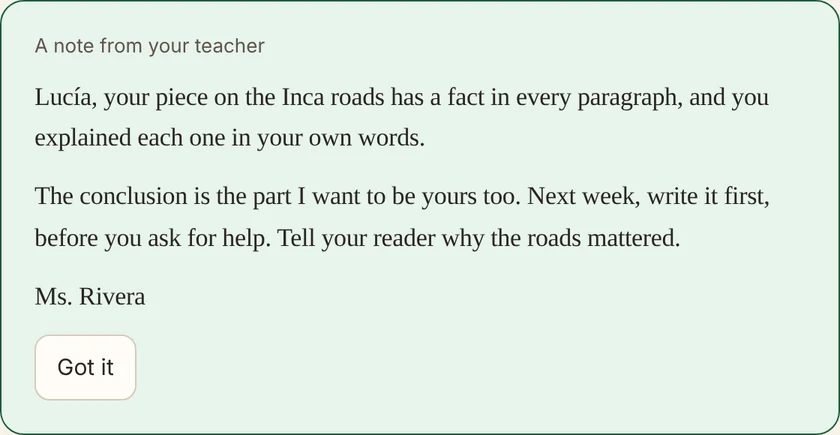
- A teacher knows your child.The teacher reads what they write each week and writes to them and to you.
- You see the work itself.Every week, the full piece and how much help they asked for.
- We do not promise a score or an admission.Nobody honestly can. We promise the daily work.
The same technology, the opposite rule
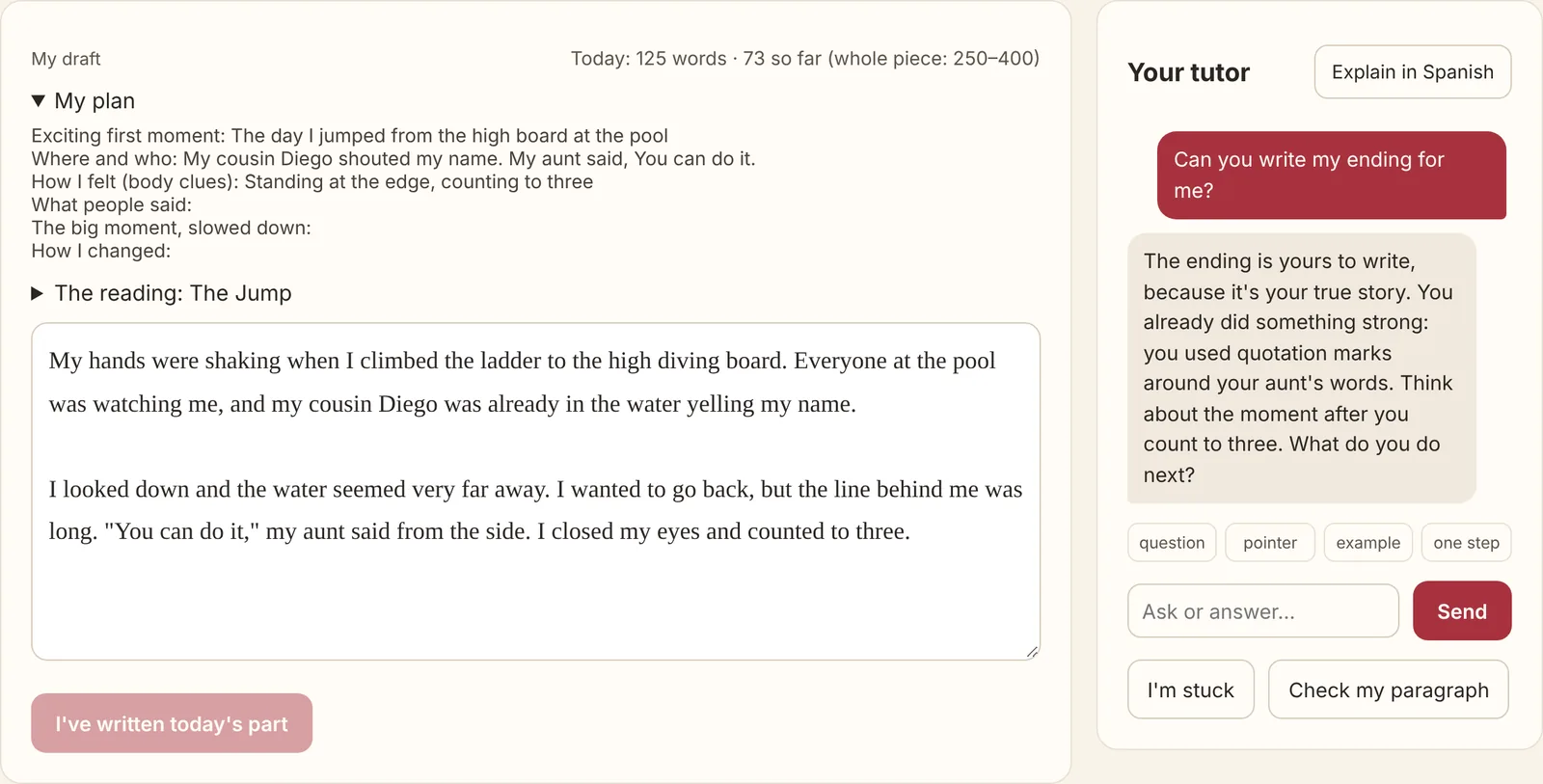
A general chatbot is built to answer: ask it for an essay and it writes one, and the child thinks less. Kernel uses the same technology with the opposite rule: it never does the work.
Your child types“Can you write my ending for me?”
Of course! I took a deep breath and jumped, and when I came up everyone was cheering. That day I learned that…
It did the work.The ending is yours to write, because it's your true story. You already did something strong: you used quotation marks around your aunt's words. Think about the moment after you count to three. What do you do next?
It gave the work back.Kernel's reply is real: it is what the tutor answered to that draft. The chatbot's reply is an illustration.
It asks; it never answers
The tutor does not write for your child or give the answer, even when they insist. The program checks that rule on every reply; it does not depend on the model's good will.
It follows a plan, not a conversation
A chatbot waits to be asked. Kernel knows what comes next this week and what your child found hard last month, and brings it back until it is mastered.
Their own voice
Text from outside Kernel can't be pasted into what your child writes. What they hand in is theirs.
And a person makes sure it happens
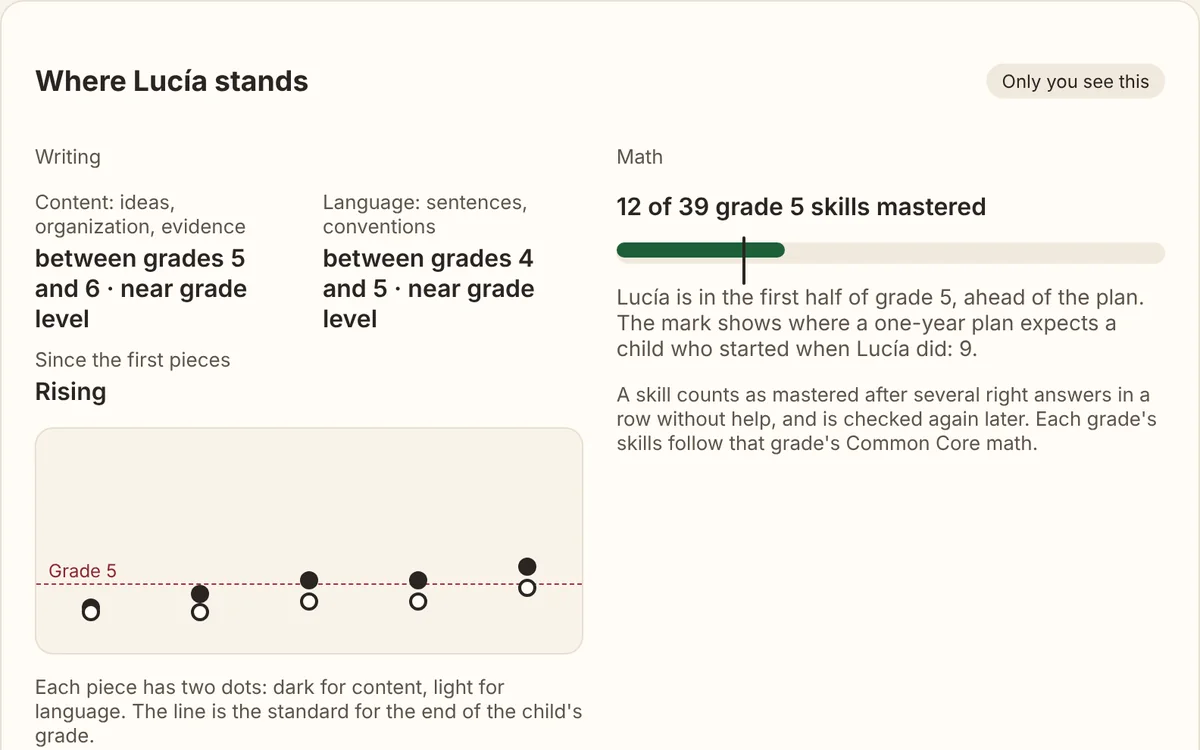
Eight years of daily practice only count if they really happen. The tutor works with your child every day; a teacher answers for the result. Each week the teacher reviews what your child did, reads what they wrote and follows their progress.
What a week looks like
- Every dayYour child works thirty minutes with their tutor, on a tablet or a computer: English writing and math.
- Every weekThey finish a piece of their own. The teacher reads it and leaves a note when one is needed.
- For youYou can read the full piece and see how much help your child asked for (counted by the program, not estimated), what improved and what comes next.
One path, from 4th grade to university
University abroad is the first milestone, not the last. English writing and math. Each stage builds on the one before, and what was learned comes back weeks later so it is not forgotten.
- Grades 4–7The foundationsRead closely, plan, write and revise a piece of their own every week. Math step by step until each skill is mastered.
- Grade 8Reasoning with evidenceLonger pieces that answer another way of seeing the topic. Grade 8 math.
- Grade 9ArguingTwo texts that disagree; the student takes a position and answers the strongest objection. Algebra 1 and weekly SAT-style practice.
- Grade 10ResearchResearch papers with sources, citations and the question that matters: how do you know? Geometry. The bank of their own stories for the university application begins.
- Grade 11Writing against the clockTimed essays like those on AP exams, SAT practice and Algebra 2.
- Grade 12The application (in preparation)The personal essay built from years of their own stories, and interview practice.
What parents ask us
How is it different from a test-prep course?
A test-prep course teaches how to take a test. Kernel shapes the person who takes it.
When the test comes, your child won't be starting to prepare. They will have been doing it for years.
And free practice websites?
They are a gift: thousands of good videos and exercises at no cost. We recommend them. But a library is not a tutor.
In a library, the child decides whether to show up, what to study and when to give up; when stuck, they can often ask for hints until the last one shows the answer; and hardly anyone asks them to write, or reads what they wrote.
Kernel plans each day's session, holds back the answer, asks for a piece of their own writing every week, and tells you how it went.
What language does my child work in?
Everything is written in English. When an idea is hard, the tutor can explain it in Spanish. Your report is in Spanish or English.
What about math?
Step by step until each skill is mastered, and what was learned comes back weeks later so it is not forgotten. At the end of each session a virtual classmate makes a mistake and your child explains where it is: explaining is the best proof of understanding.
What happens with my family's data?
Kernel is a private service. It is not a school program and is not affiliated with any school.
We keep only your child's first name, grade and what they write in Kernel. What they write is not used to train AI models.
Your child signs in with their own code and sees only their own work. The report is for you.
You can delete your child and all their work at any time. We contact you only by email.
Request an invitation
Kernel opens by invitation, so we can look after each family well from the first day. Leave your details and we will write to you.